LEAD PRODUCT DESIGNER
Turning confusion into clarity for transaction declines

Project brief
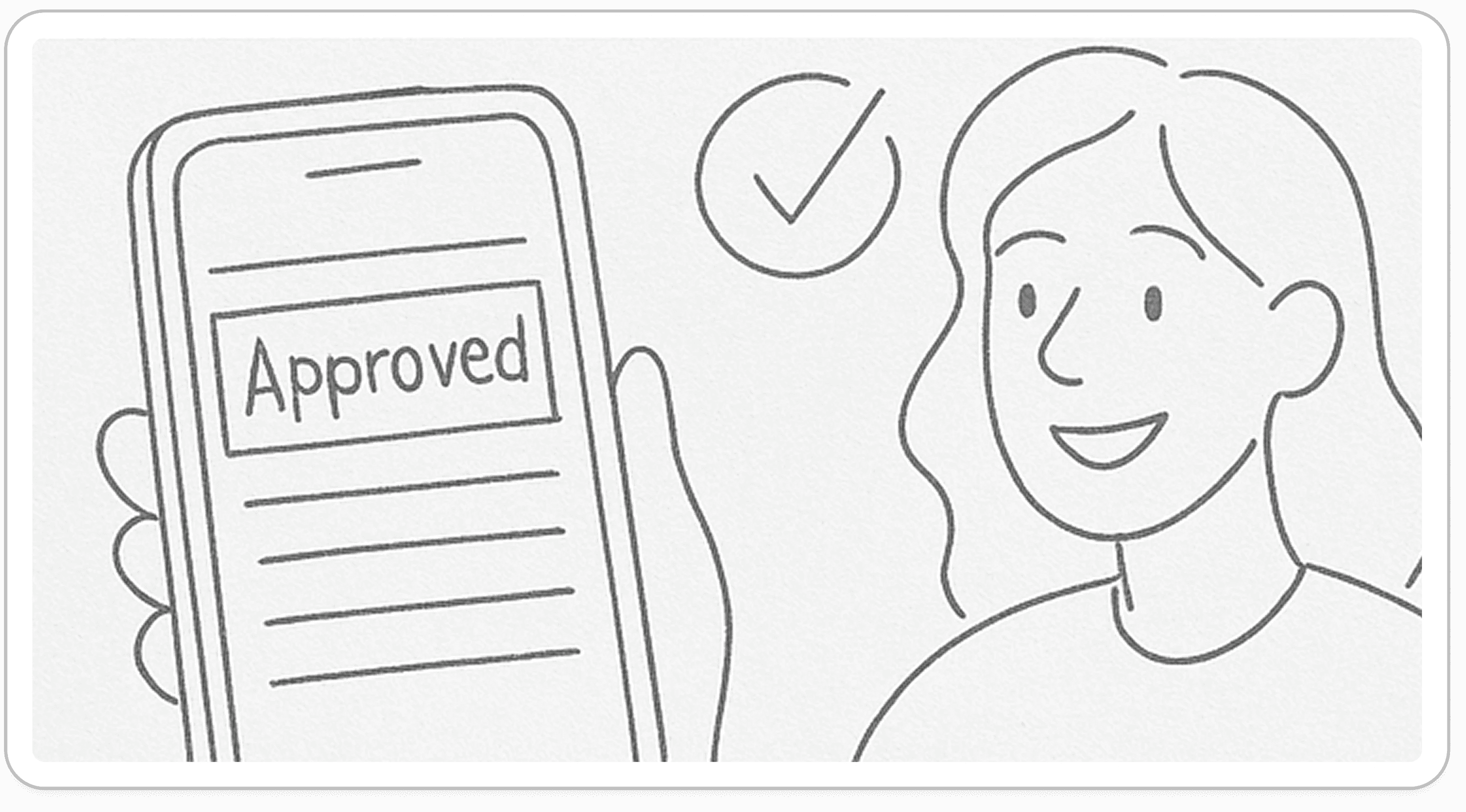
Card transaction declines were a top NPS detractor at USAA; members felt confused, embarrassed, and rarely understood why their payment failed. Building on service blueprints I had already created for debit card NSF scenarios, I led a project to map the broader declines experience across digital, POS, and servicing channels. I synthesized data, Voice of Member feedback, and operational flows into a clear narrative and a new service blueprint for credit card over-limit declines, then framed key opportunities to make declines clearer, more proactive, and easier to resolve. This work now serves as the foundation for identifying, prioritizing, and delivering work around other big milestones that are currently being shared with the president and leadership of the bank.
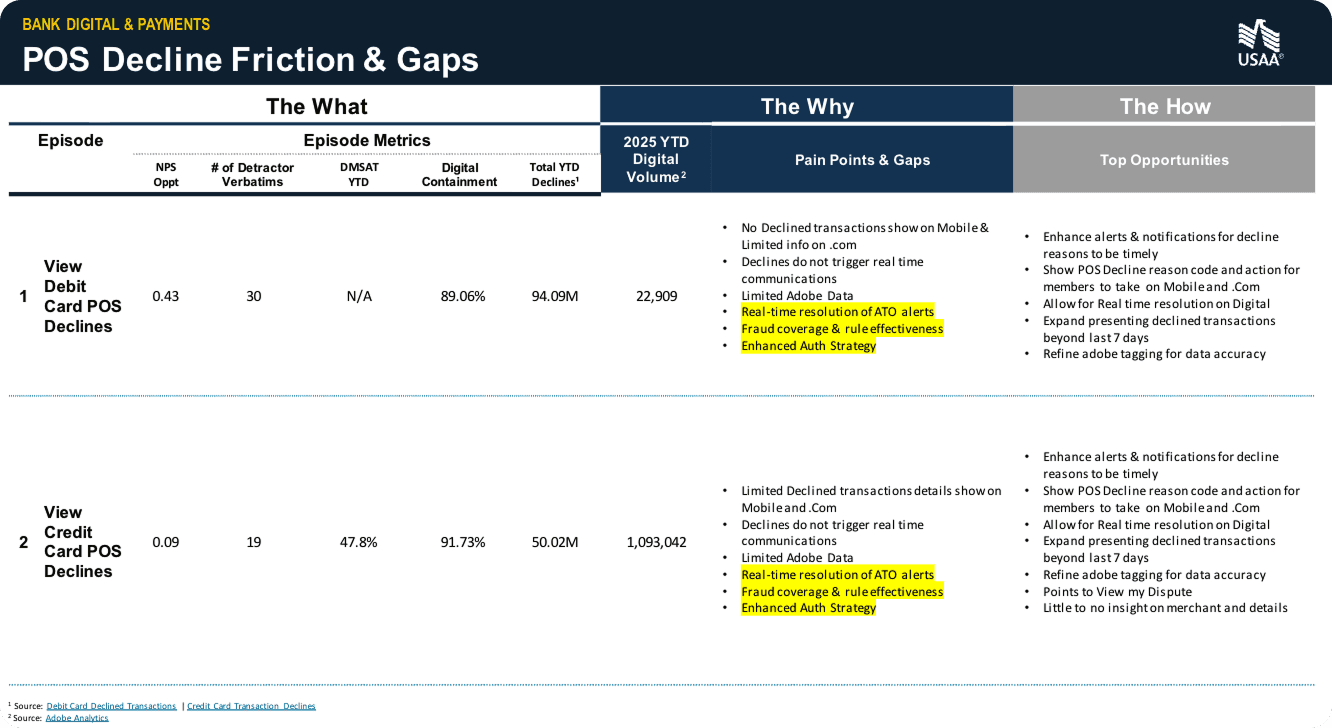
Figure 1. the summary of the what, why and how.
Context & Challenge
By early 2025, the bank president had launched a new enterprise push to fix our biggest NPS detractors (servicing six). Transaction declines were on the list, so there were plenty of meetings happening, but no shared picture of the problem. Different groups were talking in parallel (fraud worried about models, cards about loss rates, digital about UI, the contact center about handle time), and the right people weren’t always in the room at the same time. We were at real risk of spending another quarter talking about “declines” without actually agreeing on what was broken.
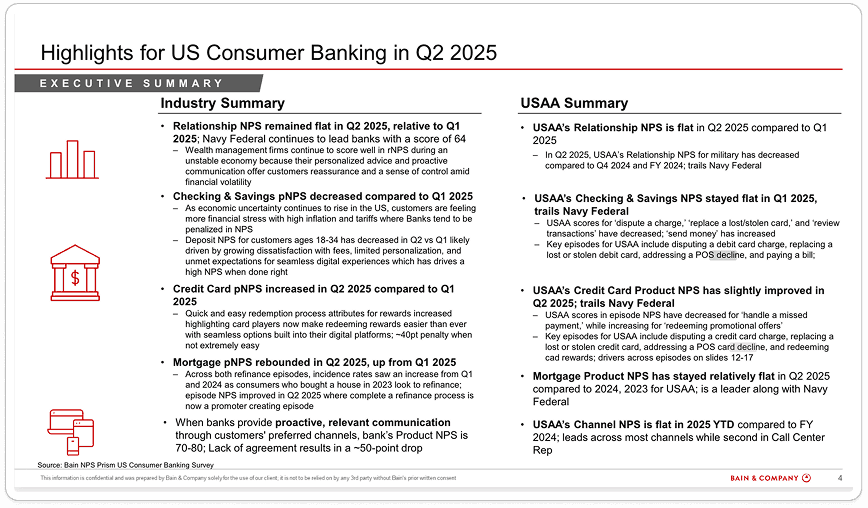
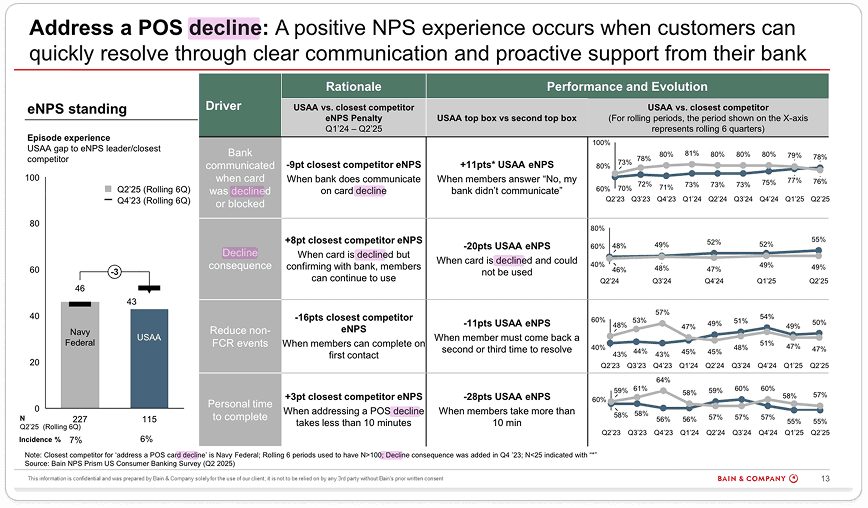
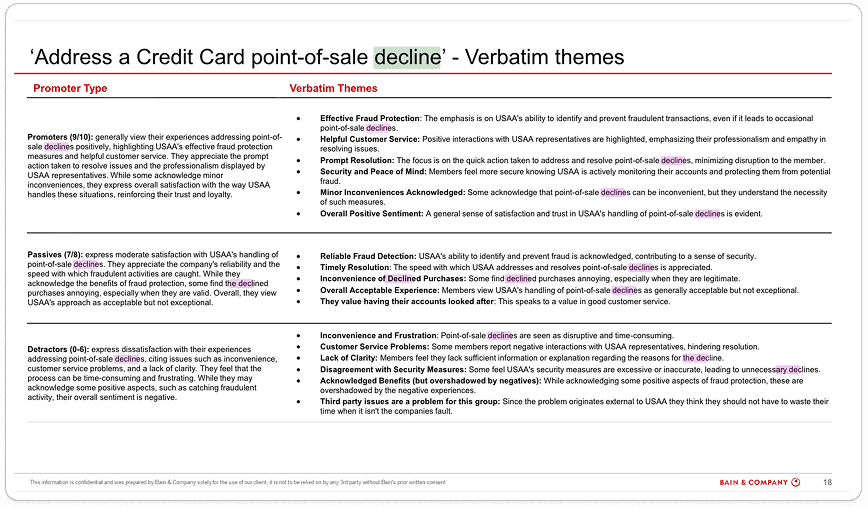
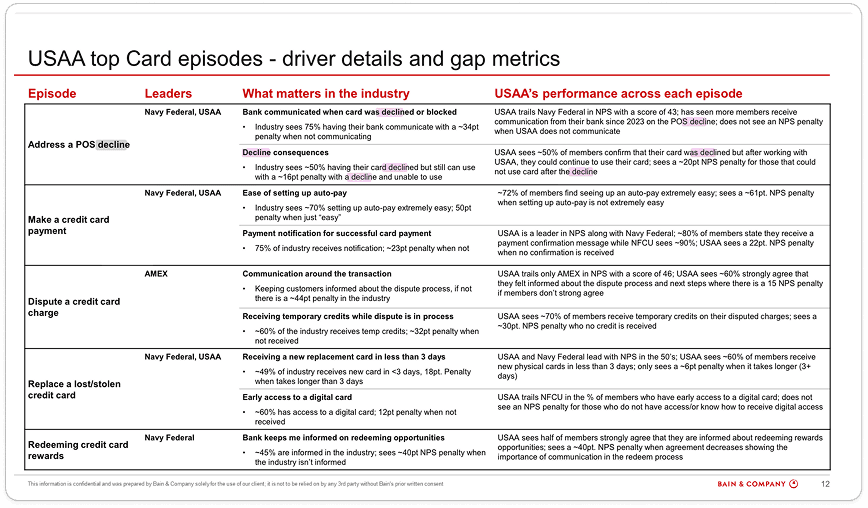
While those conversations spun up, I started independently mapping the space. I pulled industry benchmarking and partnered with a decision science analyst to quantify the impact: external Bain studies and our own NPS dashboards showed point-of-sale card declines were among the most painful episodes for members, with clear gaps versus our closest competitors. Layering in Voice of Member, MSAT, and OSAT data, a consistent pattern emerged when a payment was declined, members didn’t just hit a technical error; they felt confused, embarrassed at the checkout line, and unsupported, with no clear explanation of what happened or what to do next. Declines weren’t just a system event; they were a trust event, and until this work, no one had stitched that story together end-to-end.
Quantitative Deep Dive: How Big Is the Problem?
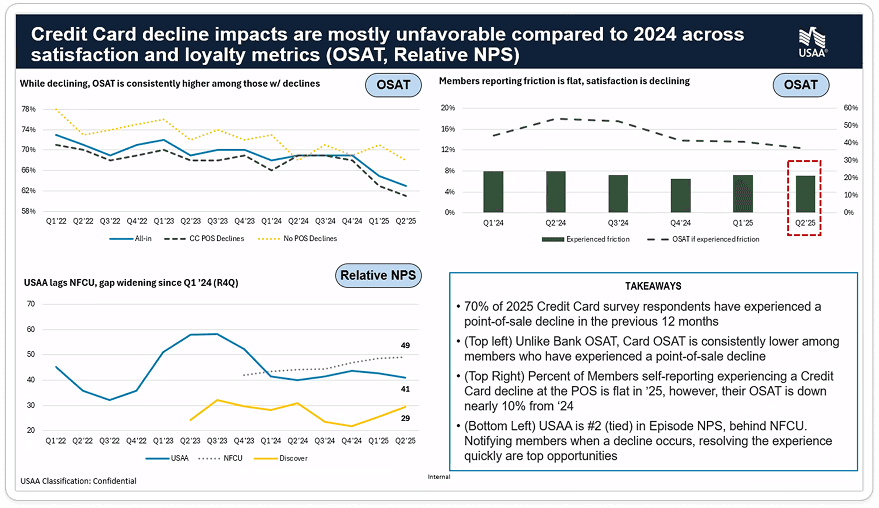
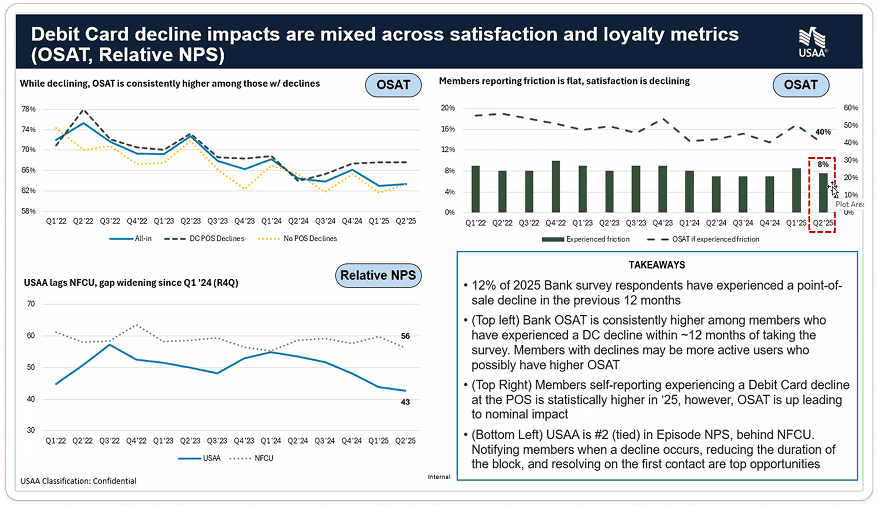
To move the conversation beyond opinions, I led a quantitative deep dive with partners in analytics, experience measurement, and risk. I defined the questions and pushed for a cross-source view of card declines that stitched together what had previously lived in separate decks. We looked at NPS and OSAT by episode, friction drivers, and decline volumes by code, and then overlaid high-level industry benchmarks to see where USAA was underperforming.
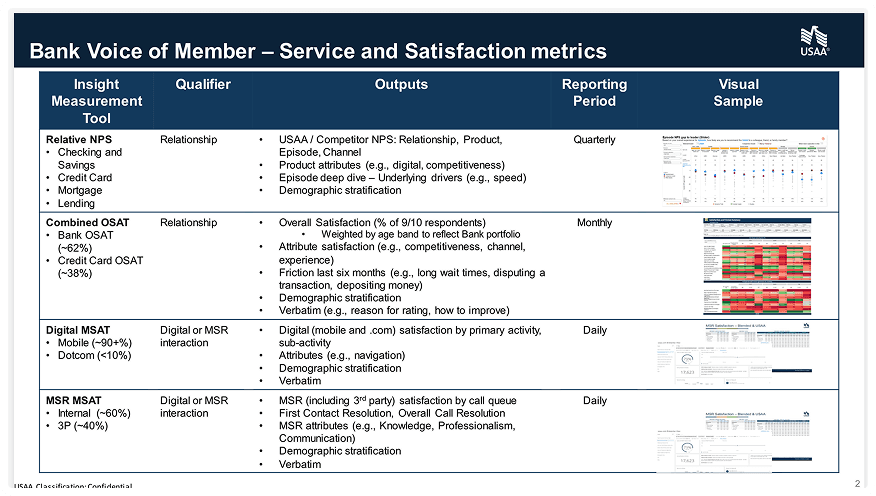
Figure 6. Voice of Member
Member & Market Insights
Numbers alone don’t move hearts, so I led a second pass focused on qualitative and competitive insight. I went through 500+ Voice of Member comments, call verbatims, and prior research to understand how declines felt from the member side—where the embarrassment started, where confusion spiked, and where trust broke. Then I paired that with a competitive scan of how banks like Chase, Wells Fargo, and Capital One communicate declines and recovery paths, looking specifically at how clearly they explain what happened, how fast, and what the member can do next.
This combination of member stories + competitor reality check made it very hard for stakeholders to say “it’s just a risk problem” and helped reposition declines as a member experience and trust problem we needed to own.
Turning insights into a story stakeholders couldn’t ignore
Once the analysis was done, it wasn’t enough to have a stack of charts and quotes, I needed a story people could see. I put my storytelling hat on and built a single synthesis map (Figure 9) that pulled everything together for our partners: what members were saying, what our data showed, and how competitors were already doing this better.
Figure 9 visualizes four core member pain themes:
False declines & fraud-prevention issues. Legitimate transactions were being declined too often, leaving members feeling punished by the very controls meant to protect them.
Lack of communication. When a decline happened, members rarely received timely, clear explanations or guidance. No text, no notification, no “here’s what to do next.”
Customer service access & quality. When members did seek help, they hit long waits, rigid scripts, and agents who often didn’t have enough context to resolve the issue confidently.
Holds and payment processing. After the decline, funds and available credit sometimes felt “stuck,” creating downstream frustration as members waited days for balances to update.
Below that, I contrasted our reality with how Chase, Wells Fargo, and Capital One handle similar situations. Their approaches clustered around four themes: proactive education (teaching customers before things go wrong), timely communication (real-time alerts and clear reasons), customer control (strong self-service tools and card controls), and technology innovation (using data and AI to reduce false positives instead of just saying “no” more often), basically we were playing catch-up.
Seeing all of this on one page shifted the conversation. Declines stopped looking like a vague “risk issue” and started reading as a solvable experience gap, with a clear set of member pain points and a proof point that competitors were already moving. Figure 9 became the anchor artifact I used to walk leaders through why we needed to act and where the biggest opportunities were.
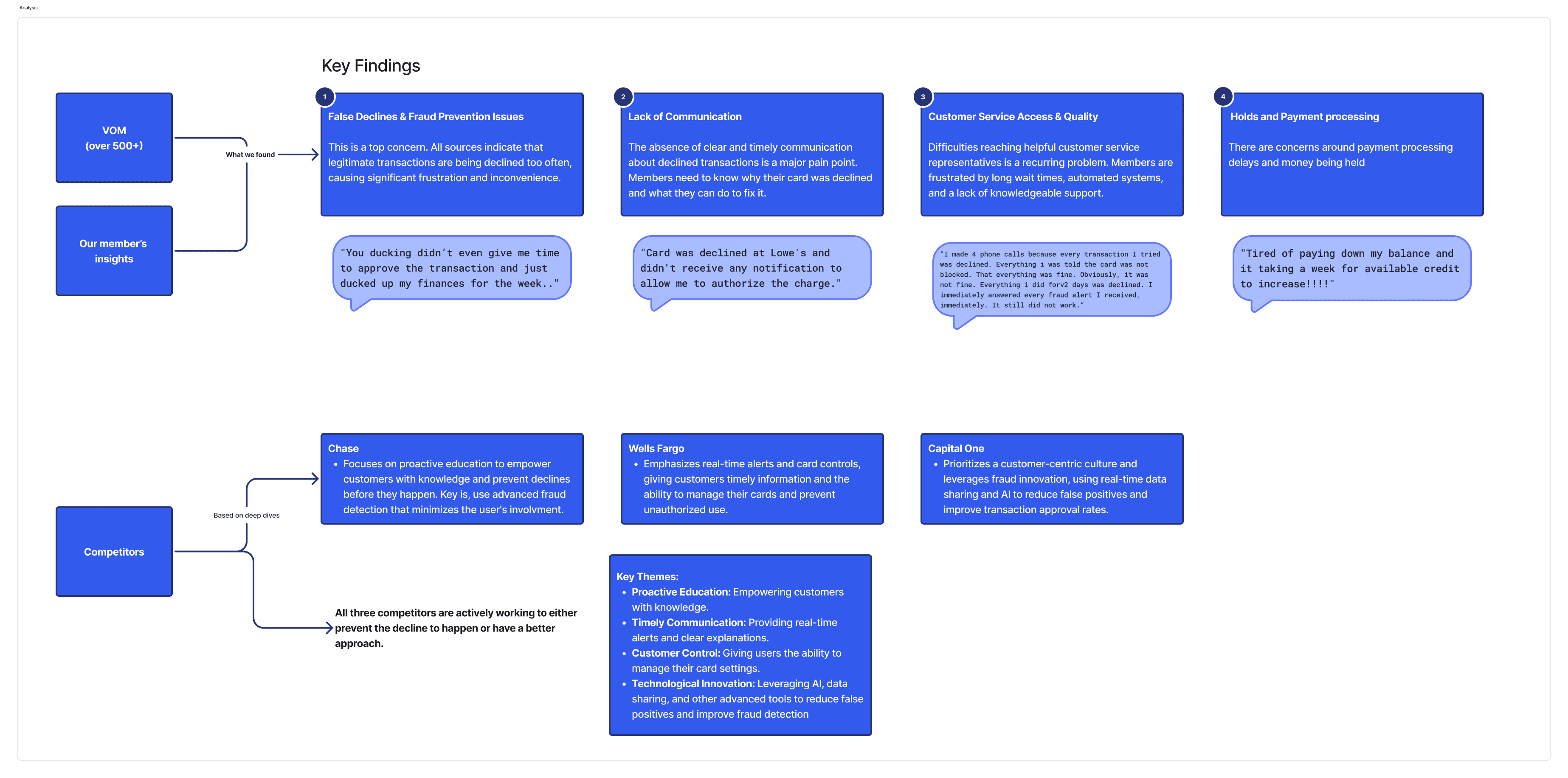
Figure 9. Key Findings map
Storytelling: From Data to Maria’s Story
To align executives and non-design partners, I translated all of the analysis into a single, human story anchored on a composite persona, Maria—a longtime USAA member experiencing repeated POS debit card declines. I mapped her journey end-to-end (Figure 10), from the moment her card is declined at the grocery store, through the confusing app experience and calls for help, to the point where she starts questioning whether staying with USAA is worth it.
This narrative became the spine of our executive readouts. Instead of opening with charts, we started with Maria at the checkout line and walked leaders through her emotional and operational journey, then used the data to show how often her story repeats across the portfolio and how it shows up in NPS and MSAT scores. The shift from “a lot of declines” to “this is what a decline actually feels like for our member” made the problem tangible and created urgency to act.
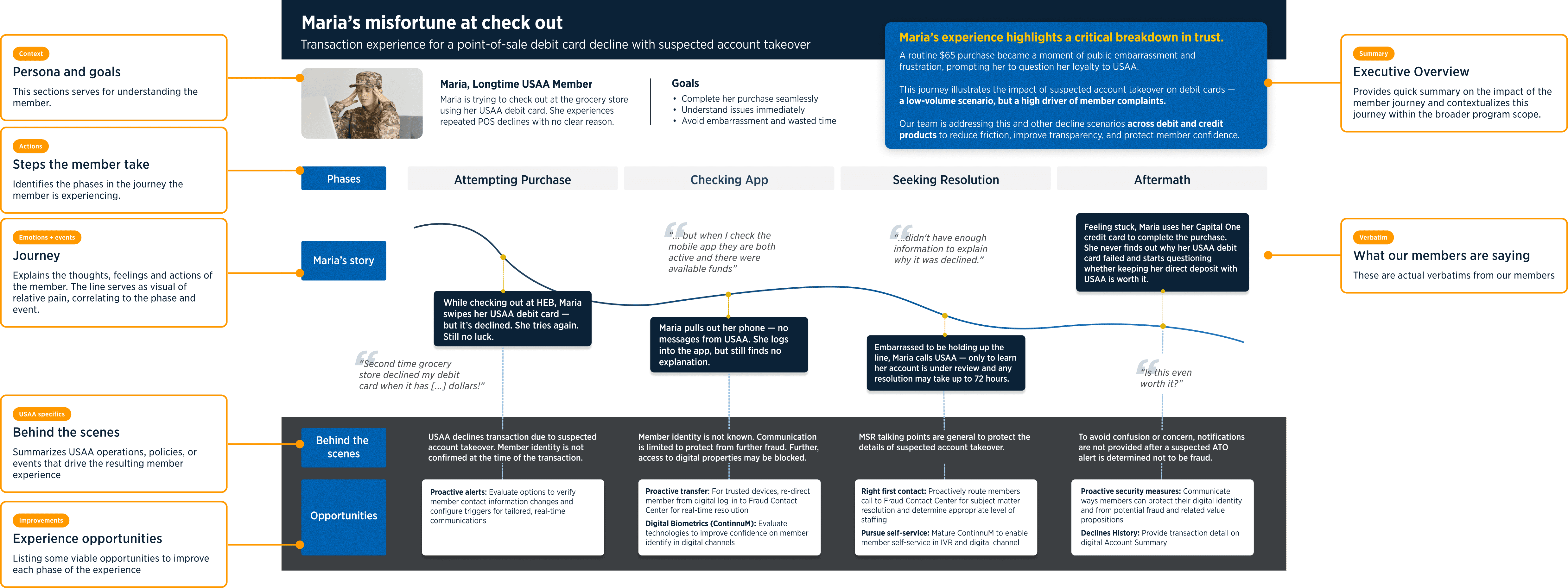
Figure 10. Journey map
From Siloed Chaos to a Shared Playbook
To move beyond abstract “fix declines” conversations, I brought together a cross-functional group from fraud, credit risk, cards, digital, and the contact center and led the creation of a true service blueprint for credit card over-limit and suspected-fraud declines. Using IPL/process views as a backbone, I mapped how a single decline travels through real-time authorization, fraud models, credit decisioning, case management, and ultimately into the app, notifications, IVR, and agent scripts. This work made visible, often for the first time, where ownership was unclear, where hand-offs broke, and how each team’s local optimization was hurting the member experience.
With that current-state grounded, I facilitated working sessions to turn the chaos into a simple opportunity framework everyone could rally around. We aligned on two experience pillars: Context + Efficiency (make it obvious what happened and what to do next through clear decline states, member-friendly reason labels, and in-context troubleshooting paths) and Proactivity + Intuitive (reduce surprise declines through smarter alerts, plain-language nudges, and stronger self-service flows). For each opportunity, we agreed on success metrics like episode NPS, MSAT for decline-related calls, first-contact resolution, and call volume tied to unclear declines.
The result was more than a set of diagrams—it was a reset for a fragmented effort. Leaders now had a single narrative (“Every month, 40M+ transactions are declined…”) that reframed declines as a member-experience and trust problem, not just a risk or ops issue; an executive-level journey and blueprint used to brief card, fraud, and digital leadership and shape the 2025 backlog; and a prioritized, principle-driven opportunity set that partnering teams are using as the foundation for concrete feature work like improved transaction feed messaging and proactive notifications.

Figure 10. Blueprint
My Role & What I Learned
As a Senior Product / Service Designer, I acted as the bridge between analytics, operations, and design. I pulled together fragmented data and decks, shaped them into a single narrative leadership could act on, and turned that story into concrete artifacts: service blueprints, journey maps, and an opportunity framework the teams could actually use to prioritize work.
What I learned
Data storytelling is a superpower. Executives don’t need 40 slides; they need one clear story that ties member pain to business impact and shows a believable path forward.
Service blueprints are non-negotiable for cross-system problems. Without a shared map, teams optimize their own piece and the member’s experience doesn’t improve.
You can’t “fix” declines with UI alone. Real change requires partnering deeply with fraud, credit risk, and contact center teams—and being willing, as a company, to explain more to members in plain, human language.
Designed in
© Copyright 2026